The first Author-Educator talk of the 2013-2014 school year is happening on September 28th at 11:00 am when Tanya Lee Stone talks about the research that goes into her nonfiction books and how facts become a compelling story. Here is a sneak preview of the second talk, happening October 26th with the Voelkels, authors of the Jaguar Stones series.
Jon and Pamela Voelkel put a lot of planning into their school presentations about Maya culture, research, and their popular Jaguar Stones books. They've got an action packed, fast paced approach that is designed to align with Common Core Standards for Science and Social Sciences in grades 6-8. And when we say action packed, that includes adventure tales from their time traveling through the rainforests of Central America, multimedia visuals, theater, and fried meal worms (if you're curious, the worm snacks are sold here).
On their website http://www.jaguarstones.com the Voelkels also have lesson plans, guides to classroom projects, and suggested resources for studying the cultures and history discussed in their presentation.
In short, this writing team has worked hard to become expert in making the most out of every minute they spend in schools. Along the way, they've learned a lot about how teachers can make the most out of any author visit, not just theirs. On Saturday, October 26th, at 11:00 am the Voelkels are coming to Bear Pond Books to share their tips and insights.
Join us on October 26th to talk about getting students engaged in author presentations, connecting these presentations to Common Core Standards, preparing for a visit, following up a visit with classroom lessons and activities, questions to ask authors and information to provide for them. . . and any other questions you might have about using author visits in your school.
See also the follow-up post on Author Adventures

Welcome to the Bear Pond Books educators' page with information on events, book lists, and articles about local authors.
Wednesday, September 11, 2013

Thursday, September 5, 2013
Tanya Lee Stone - Saturday, September 28th - Nonfiction for Young Readers
On Saturday, September 28th, we're excited to kick off a great year of author talks for educators with Tanya Lee Stone. Please join us at 11:00 am in the Children's Room at Bear Pond Books. We'll be talking about how to write a compelling story while sticking to the facts, with a focus on works for elementary and middle school age children.
Last winter, authors Rebecca and Joshua Rupp presented a great talk on writing creative nonfiction, which they define as "nonfiction with personality" (notes from that talk are here).
On September 28th, we're returning to nonfiction with personality when author Tanya Lee Stone joins us with a talk on "A Fine, Fine Line." The title comes from a 2011 article she wrote on blurring (or, more accurately, not blurring) the line between fact and fiction.
Why is the line between fact and fiction so fine? Because writing a narrative is different from taking a true / false test. Authors need to convey not only that events happened, but also the emotion behind what happened and a storyline that draws readers into the history. The techniques of fiction writers help create the emotion, character and story. Sometimes, though, writers cross the line into fiction - with dialogue that's imagined for the purpose of illustrating a point, emotions that are likely but not documented, opinions that are intuited but not cited. Okay, if you announce you're writing fiction, not okay, Tanya says, if you don't..
Tanya explains that strictly staying to fact means "If I write that Jerrie Cobb’s smile was tinged with sadness, the reader needs to know I do so with authority. That I have seen that smile or have some other documented knowing of it."
So, then, how does a nonfiction writer do the research needed to stand behind each word? And how does she craft a compelling tale that remains on the nonfiction side of the line?
As Tanya writes "We don’t need to manipulate the facts to be effective storytellers. We don’t need to invent to be inventive. The facts, in the right hands, are as entertaining as any fiction." Find out about her approach to research, writing and documenting history for young readers on September 28th at 11:00 am in the Children's Room.
If you're interested in this topic, you might also be interested in these articles on historical fiction from our March, 2013, talk with Jenny Land and Natalie Kinsey Warnock.
For a follow up post on this event, click here to read "Using the Craft of Fiction to Tell Nonfiction Stories." And read about all Bear Pond Books events at our website www.bearpondbooks.com
More Information on Tanya Lee Stone
Tanya Lee Stone is a former editor and the Robert F. Sibert Award–winning author of Almost Astronauts: 13 Women Who Dared to Dream. Her most recent nonfiction book, Courage Has No Color, was almost a decade in the making, as she did extensive original research into the Triple Nickles, the U.S.'s first African-American paratroopers who fought in World War II. Her most recent picture book Who Says' Women Can't Be Doctors? was named one of the year's top 10 biographies by Booklist.
Some readers may also know Tanya from her 2010 book The Good, The Bad, and the Barbie, which won the Golden Kite Award. In all, she has written almost 100 books for kids.
Coming Up This Fall
In October we'll be inviting local authors in to talk about making the most of an author visit to your classroom. Stay tuned for the final date. Any good tips to share? Send them to helen.labun.jordan @ gmail.com or via Twitter @BearPondBooks
Last winter, authors Rebecca and Joshua Rupp presented a great talk on writing creative nonfiction, which they define as "nonfiction with personality" (notes from that talk are here).
On September 28th, we're returning to nonfiction with personality when author Tanya Lee Stone joins us with a talk on "A Fine, Fine Line." The title comes from a 2011 article she wrote on blurring (or, more accurately, not blurring) the line between fact and fiction.
Why is the line between fact and fiction so fine? Because writing a narrative is different from taking a true / false test. Authors need to convey not only that events happened, but also the emotion behind what happened and a storyline that draws readers into the history. The techniques of fiction writers help create the emotion, character and story. Sometimes, though, writers cross the line into fiction - with dialogue that's imagined for the purpose of illustrating a point, emotions that are likely but not documented, opinions that are intuited but not cited. Okay, if you announce you're writing fiction, not okay, Tanya says, if you don't..
Tanya explains that strictly staying to fact means "If I write that Jerrie Cobb’s smile was tinged with sadness, the reader needs to know I do so with authority. That I have seen that smile or have some other documented knowing of it."
So, then, how does a nonfiction writer do the research needed to stand behind each word? And how does she craft a compelling tale that remains on the nonfiction side of the line?
As Tanya writes "We don’t need to manipulate the facts to be effective storytellers. We don’t need to invent to be inventive. The facts, in the right hands, are as entertaining as any fiction." Find out about her approach to research, writing and documenting history for young readers on September 28th at 11:00 am in the Children's Room.
If you're interested in this topic, you might also be interested in these articles on historical fiction from our March, 2013, talk with Jenny Land and Natalie Kinsey Warnock.
For a follow up post on this event, click here to read "Using the Craft of Fiction to Tell Nonfiction Stories." And read about all Bear Pond Books events at our website www.bearpondbooks.com
More Information on Tanya Lee Stone
Tanya Lee Stone is a former editor and the Robert F. Sibert Award–winning author of Almost Astronauts: 13 Women Who Dared to Dream. Her most recent nonfiction book, Courage Has No Color, was almost a decade in the making, as she did extensive original research into the Triple Nickles, the U.S.'s first African-American paratroopers who fought in World War II. Her most recent picture book Who Says' Women Can't Be Doctors? was named one of the year's top 10 biographies by Booklist.
Some readers may also know Tanya from her 2010 book The Good, The Bad, and the Barbie, which won the Golden Kite Award. In all, she has written almost 100 books for kids.
Coming Up This Fall
In October we'll be inviting local authors in to talk about making the most of an author visit to your classroom. Stay tuned for the final date. Any good tips to share? Send them to helen.labun.jordan @ gmail.com or via Twitter @BearPondBooks
Thursday, May 23, 2013
Summer Reading
Here are some summer reading recommendations, by grade level, from Jane in the Children's Loft. . .
Pre-K - Kindergarten
Fun, new (and a few older) picture books for kids entering school for the first time.
- This Is the Way We Go To School by Edith Baer
This
rhyming book celebrates the way children get to school around the
world. Can be an interesting way to introduce new riders to the school
bus.
- In the Garden: Whos Been Here? by Lindsay Barrett George
This
is part of a successful series that draws you into our seasonal
habitats (forest, snow, pond and garden) and helps you discover who
lives in each. Simple text and helpful factual information that's not
overwhelming for little people.
- Fireflies by Julie Brinkloe
Another
perfectly summertime tale in which a boy feels like he "owns a piece of
moonlight" though he realizes he must set the fireflies free.
- Sunflower House by Eve Bunting
A magical story about growing a sunflower house and all the creativity it inspires. A perfect summer story.
- Don't Let the Pigeon Finish This Activity Book! by Mo Willems and YOU
The
infamous Pigeon helps create the fun in this wildly imaginative
activity book. Will keep the summer rainy day blues in check.
- The Sandwich Swap by Rania Al Abdullah
This
sweet picture book depicts a seemingly silly fight between best
friends, but helps us understand how important it is to embrace
differences and new things (even if it is a peanut butter and jelly
sandwich! yuck!)
- Outside Your Window: A First Book of Nature by Nicola Davies
This is a stunningly illustrated introduction to nature and poetry.
- How Did That Get In My Lunchbox?: The Story of Food by Chris Butterworth
It's
never too early to make the connection between what we pull out of our
lunch boxes and what grows in our gardens and on our farms. Lots of
Vermont kids may already be steeped in this knowledge but it is the
first picture book to do a decent job with the topic.
- Bailey by Harry Bliss
Bailey
is a dog who enjoys going to school-- he just gets distracted
sometimes, and eats his homework. But he always tries his best. Kids
will love the idea of sharing their day in the classroom with a
character as likeable as this.
- Off To Kindergarten by Tony Johnston
This
sweet story explores the first day jitters as Bill decides he
absolutely needs to bring a few favorite things with him on the first
day.
First - Second Grades (ish)
These are a mixture of early readers, picture books and short chapter books for emergent readers.
- Velma Gratch and the Way Cool Butterfly by Alan Madison
Watch
the transformation of Velma from a less-than-noticeable brand new first
grader to a person of great interest (especially to the monarch!) in
this sweet and informational tale.
- Pete the Cat at the Beach by James Dean
There’s
just something about Pete-- is it his groovy shoes or his groovy
attitude? You just can’t resist this cool cat’s charm, even if he is a
little afraid of the ocean.
- Penny and Her Doll by Kevin Henkes
Penny
isn’t groovy-- but she has all the charm and earnestness of a spring
day. Henkes hits all the right notes with this series.
- Look Up! Bird-Watching in Your Own Backyard by Annette LeBlanc Cate
In
their own words, cartoon-style these familiar birds invite young people
to pay attention and get out a sketchbook. Quirky and interactive, this
book invites a whole new generation to an age-old hobby.
- Jet Plane: How It Works by David Macaulay
This
is a new series based on the definitive book The Way Things Work, pared
down and simplified for the needs of emerging readers. The series also
includes castles, the eye and (my favorite) the toilet.
- Bramble and Maggie: Horse Meets Girl by Jessie Haas
Vermonter
and horse woman Haas introduces us to a girl who has been looking for a
horse to love. Bramble has been looking for someone to take her away
from her life of routine--is it a perfect match? With genuine horsey
wisdom and humor Haas brings her love of animals to a fresh new series.
- Lulu and the Duck in the Park by Hilary McKay
This
chapter book is filled with humor, heart and wonderful illustrations.
Lulu is a biracial child portrayed in a multi-racial classroom which is
plenty welcome in the genre. Classroom chaos provides for plenty of
comic relief for animal lovers and the rest of us, too.
- Rabbit and Robot: The Sleepover by Cece Bell
The
odd couple-- fussy rabbit and logical robot-- provide much amusement on
a sleepover that Rabbit has planned from start to sleep. However,
things don’t quite go as planned (who would’ve thought that Robot like
nuts and bolts on his pizza?) and the reader has a blast watching these
two figure it out. Simple text, but much to love.
- Dog Diaries by Kate Klimo
This
early chapter series (like the much loved Horse Diaries) tells each
story from the dog’s point of view, each dog being a different breed.
Dog facts, history and lore in each.
- Nancy Clancy, Super Sleuth by Jane O’Connor
Fans
of Fancy Nancy can grow up with her as she becomes a young detective in
this new series. Another beloved character-- Amelia Bedelia now stars
in her own chapter book series, too.
- Heroes in Training by Joan Holub
This
is a great age to introduce Greek Myths-- there are many ways to begin
(D’aulaire’s, Mary Pope Osborne’s Tales from the Odyssey) but here is a
action-packed series for new readers not quite ready for Percy Jackson.
Third - Fourth Grades (or so)
Increasing depth, complexity and comprehension
Max
reinvents himself at summer camp, and has a bumpy time merging his two
personae when he returns to his regular life and old friends. Max is a
likable kid who makes some questionable choices, like we all do. A great
summer camp read.
- Bliss by Kathryn Littlewood
A
little magic, and a bake shop is the perfect recipe for summer fun. The
Bliss family is a little eccentric, one of those zany families we’ve
all wished to be a part of at one point or another.
- The Year of the Book by Andrea Cheng
When
friendships get a little complicated, Anna turns to her books for
comfort. However, real life friendships can be much trickier to
navigate. Book lovers will find a lot to love in this quiet,
well-written gem.
- Pie by Sarah Weeks
Yes,
another book about food! But who doesn’t like pie?! And well, this has a
fun mystery twist that involves a not-so-loveable cat named Lardo. Need
I say more?
- Lunch Lady series by Jarrett Krosoczka
The
Lunch Lady serves lunch....and justice! This is a friendly,
action-packed graphic novel series for kids who like serious fun. The
graphics are easy to follow, and the story keeps them coming back for
more.
- Nathan Hale’s Hazardous Tales by Nathan Hale
From the same author who brought us Calamity Jack and Rapunzel’s Revenge, here are some seriously well-crafted graphic novels that tell about some of the livelier events in history. Big Bad Ironclad covers the history of the amazing ironclad steam warships used in the Civil War. One Dead Spy tells the strange but true story of an officer and spy for the American rebels during the Revolutionary War.
- Justin Case by Rachel Vail
Justin
is a worrying kind of kid, but his (mis)adventures are comic and his
heart is big. Fans of Diary of a Wimpy Kid will enjoy Justin’s will
appreciate the doodle-like illustrations though Justin is thoroughly his
own winsome character---- even if he does worry a lot.
- Tuesdays at the Castle by Jessica Day George
This
is the start of a perfectly tailored fantasy series for readers who
might not be ready for Harry Potter-- it is engaging and engrossing
without being “too much” for younger readers. And at the heart of this
story is an ever-changing magic castle that can grow a new room or
change a few hallways depending in the day and its mood. Castle envy
anyone?
- Citizen Scientists by Loree Griffin Burns
A
wonderful and necessary addition to the nature investigations genre,
this book can be used in multiple situations, but as the title suggests,
is best used in the backyard and in your community. Wonderful
photography, resources and project ideas, I can’t recommend this highly
enough.
- The Center of Everything by Linda Urban
This
East Montpelier author just gets better and better--- her third novel
is expertly crafted and is infused with her signature humor. Ruby
Pepperdine is about to give her first public speech at the local Fourth
of July parade, and as the story spirals backward we get a glimpse into
her hopes, wishes and sadness. Character-driven and smart, Linda’s
novels are also great for book groups.
- Capture the Flag by Kate Messner
When
the Star-Spangled Banner is taken from its super-secure Smithsonian
vault, three kids connected by their Vermont background and family
membership in a secret artifact-protection society band together to find
the irreplaceable national treasure. A little history, a lot of
adventure and mystery.
Fifth and Sixth Grades (or thereabouts)
Reading with confidence and fluency.
- The Case of the Deadly Desperados by Caroline Lawrence
A
real western and a mystery to boot, P.K. (Pinky) is a plucky hero (with
asperger’s) who has excellent powers of observation and a keen memory.
Funny, filled with plenty of misfits and period detail and some gory
details, this should appeal to most fans of high adventure.
- Deadweather and Sunrise by Geoffrey Rodkey
A
perilous quest that involves swashbuckling pirates and treasure, poor
Egg, orphaned and living with the wealthy Pembroke family, discovers all
is not as it seems. He must discover why his benefactor is trying to
kill him why trying to find his courage and wits as well.
- Doll Bones by Holly Black
Another
quest --this time involving three friends who are trying to deliver the
ashes of a young girl to a cemetery in Ohio and put her ghost to rest.
This unique tale dons the cloak of a creepy ghost tale to deliver
bittersweet meditations on the nature of friendship, the price of
growing up and the power of storytelling.
- Twerp by Mark Goldblatt
It’s
1969 Queens, and as punishment, Julian is told he must journal about
the events leading up to a school incident (about which we don’t
actually learn until the latter part of the story). Until then, we are
treated to various other mishaps with his gang of friends, and other
bumps in the road into adolescence. Timeless issues and humorous
sketches of boyhood mischief make this an engaging read.
- Ruby Redfort Look Into My Eyes by Lauren Child
Starring in her own series is the favorite fictional heroine of Clarice Bean, as any Child fan will know. With nods to Harriet the Spy and enough wisecracks to keep you chuckling throughout, this new detective series is charming and witty from start to finish.
- Hades, Lord of the Dead by George O’Connor
- One Came Home by Amy Timberlake
Alone
in her belief that a found body is not her sister’s, plucky Georgie
sneaks away in the dead of night, determined to retrace her sister’s
steps in order to solve the mystery of her disappearance and, she hopes,
to bring her home. Set in rural 1870’s Wisconsin, against the almost
surreal setting where passenger pigeons are migrating, this historical
novel grabs you from start to finish, and it’s hard to find a more
charismatic character than Georgie.
- Cracker by Cynthia Kadohata
This
story of Vietnam is told through the eyes of a German Shepherd that
becomes trained as a military canine to help soldiers sniff out booby
traps, and through the eyes of Willie- the boy who had to let him go. A
heartfelt tale that explores the close bond of the scout-dog team and
gives insight to a little known piece in history.
- The Hero’s Guide to Saving Your Kingdom by Christopher Healy
A
delightfully creative spin on some of the most well-known fairy tales,
where princes aren’t so charming. This review pretty much sums it up:
“This is the most fun you can have short of rounding up King Arthur’s
knights, filling their armor with laughing gas, and driving them to a
roller disco.” author Frank Cottrell Boyce
Young Adults-- ages 12 and up
- The Scorpio Races by Maggie Stiefvater
Stiefvater's
novel, inspired by Manx, Irish, and Scottish legends of beautiful but
deadly fairy horses that emerge from the sea each autumn-- utterly
beguiling.
- Shadow and Bone by Leigh Bardugo
A
cast of well-defined characters and a unique magic system completes
this lavishly imagined world, where light doesn’t always conquer dark
and deception runs so deep that it becomes truth. High fantasy with a
twist of Russian fairy tale.
- Code Name Verity by Elizabeth Wein
An
unforgettable and un-put-down-able story of WWII bravery and friendship
told through the eyes of two young women serving as a spy and a pilot.
Intelligent writing and perfect pacing-- adults should read this one,
too!
- The Summer Prince by Alaya Dawn Johnson
A
dystopian novel set in Brazil, where the matriarchs rule and technology
is restricted. This meditation on art, creativity and passion fuels a
unique ride.
- This Dark Endeavor by Kenneth Oppel
A thrilling and dark exploration into the mind and drive behind Mary Shelley’s Frankenstein, this gothic tale does not let up.
- The Fifth Wave by Rick Yancey
A post-apocalyptic alien invasion story with a smart, vulnerable heroine. Another non-stop thrill ride that is deftly plotted.
- Eleanor and Park by Rainbow Rowell
This
starts as a well-written, quirky romance and turns into an all but
predictable story about the dark secrets that, when kept, can take down a
community. Thoughtful, sweet and poignant.
- Keeping the Castle by Patrice Kindl
The
perfect summer beach read--a tongue-in-cheek take on the Regency
romance. Clever and witty, with a memorable protagonist who is smart and
savvy.
- Born Wicked by Jessica Spotswood
An
alternate fantasy that borrows heavily from the New England witch
trials-- well-written with the perfect amount of romance that never
overshadows the feminist plot.
- The Obsidian Blade by Pete Hautman
Vivid imagination and deft storytelling make for refreshing speculative fiction in this time-travel tale.
- Bomb by Steve Sheinkin
Tuesday, April 9, 2013
Linda Urban & The Center of Everything
First off, most of our pictures are of doughnuts - not because the doughnuts were the most important part of Linda's reading, but because the action shots of Linda actually reading turned out blurry.
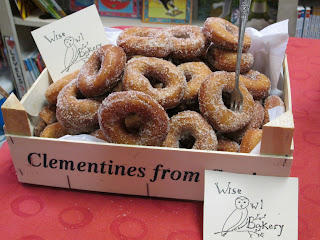
On the other hand, doughnuts are deeply symbolic. As we discussed at Saturday's book launch party for Linda Urban and The Center of Everything.
The Center of Everything's narrator, Ruby Pepperdine, lives in the town founded by the fictitious inventor of the modern doughnut's shape. She is watching the annual celebration of this founder and learning, as Linda said in her talk, "about the small towns that make us feel like we're the center of everything and also about how it's not always best to be the center, but to be connected in the circle."
For anyone who is interested in how writers structure their books, this book is for you.
The Center of Everything takes place over one day, Bunning Day, told in present time like telling a story to a friend. Ruby spends almost the entire book standing in a circle, watching the Bunning Day parade go by and waiting to read her Bunning Day Essay. A lot can happen with a narrative in that structure, trust us - there's loss of a grandparent, there are new friends and old friends, and the 12 year old narrator is starting to question what the future holds (and how she can make sure everything turns out okay). And other Bunning townspeople do get cameos in short monologue-style chapters throughout the book.
It's also a book for people who couldn't care less about the mechanics and just want a good story. But you're still encouraged to geek out over structure.
Although Linda didn't attribute her entire inspiration to Montpelier, I think it's fair to mention that the book began soon after watching Montpelier's 4th of July Parade when she realized that ". . . most of the time we walk through town, with a parade we stand still and the town walks through us." Also, there is a doughnut shop named Delish and a theater named Hungry Nation.
Just putting it out there that Montpelier is the true Center of Everything.
You can read Linda describing the book in her own words at this blog post.
This post also explains The Next Big Thing Blog Tour. It's a chain of blog posts by authors with upcoming books. One author answers a set of questions on her blog, then passes those questions on to another author to answer on *their* blog, creating one link in the tour. Then that author links a new author. And so on. Check it out and find out where the next big thing is happening (and whether they'll serve doughnuts).

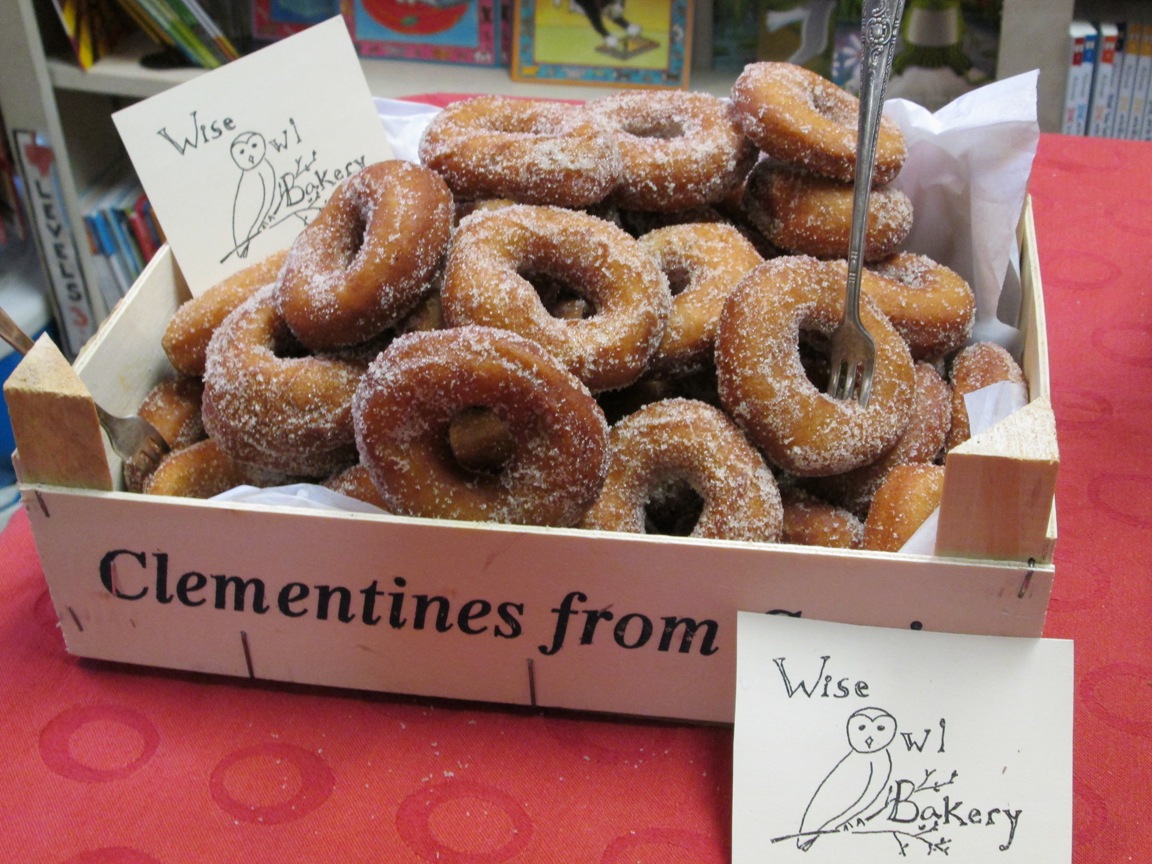
On the other hand, doughnuts are deeply symbolic. As we discussed at Saturday's book launch party for Linda Urban and The Center of Everything.
The Center of Everything's narrator, Ruby Pepperdine, lives in the town founded by the fictitious inventor of the modern doughnut's shape. She is watching the annual celebration of this founder and learning, as Linda said in her talk, "about the small towns that make us feel like we're the center of everything and also about how it's not always best to be the center, but to be connected in the circle."
For anyone who is interested in how writers structure their books, this book is for you.
The Center of Everything takes place over one day, Bunning Day, told in present time like telling a story to a friend. Ruby spends almost the entire book standing in a circle, watching the Bunning Day parade go by and waiting to read her Bunning Day Essay. A lot can happen with a narrative in that structure, trust us - there's loss of a grandparent, there are new friends and old friends, and the 12 year old narrator is starting to question what the future holds (and how she can make sure everything turns out okay). And other Bunning townspeople do get cameos in short monologue-style chapters throughout the book.
It's also a book for people who couldn't care less about the mechanics and just want a good story. But you're still encouraged to geek out over structure.
Although Linda didn't attribute her entire inspiration to Montpelier, I think it's fair to mention that the book began soon after watching Montpelier's 4th of July Parade when she realized that ". . . most of the time we walk through town, with a parade we stand still and the town walks through us." Also, there is a doughnut shop named Delish and a theater named Hungry Nation.
Just putting it out there that Montpelier is the true Center of Everything.
You can read Linda describing the book in her own words at this blog post.
This post also explains The Next Big Thing Blog Tour. It's a chain of blog posts by authors with upcoming books. One author answers a set of questions on her blog, then passes those questions on to another author to answer on *their* blog, creating one link in the tour. Then that author links a new author. And so on. Check it out and find out where the next big thing is happening (and whether they'll serve doughnuts).

Monday, March 25, 2013
The Center of Everything
We like to think of Bear Pond Books as the center of everything, Linda Urban has a new book called The Center of Everything, and we're bringing the two together April 6th at 11:00 am in the Children's Room upstairs at Bear Pond.
The Center of Everything follows A Crooked Kind of Perfect, Hound Dog True, and the picture book Mouse Was Mad.
Linda's new book features 12 year old Ruby Pepperdine at the great Bunning Day Parade, where she is going to be the Bunning Day Essay girl. And (here we're going to get a bit nerdy) it does great things with using different tenses and perspectives as the parade passes through. Playing with these elements was one of the writers' tools that Linda spoke about on her last visit to Bear Pond Books, last fall. We're looking forward to hearing about more next Saturday!
Where did Linda start creating the stories that would become her books? At a local bookstore, of course. Not our local bookstore, but close enough. Read about bookstores and more about The Center of Everything in this Publisher's Weekly interview.
Then, join us, with doughnuts, book discounts, and Linda Urban on Saturday, April 6th at 11:00 am.

The Center of Everything follows A Crooked Kind of Perfect, Hound Dog True, and the picture book Mouse Was Mad.
Linda's new book features 12 year old Ruby Pepperdine at the great Bunning Day Parade, where she is going to be the Bunning Day Essay girl. And (here we're going to get a bit nerdy) it does great things with using different tenses and perspectives as the parade passes through. Playing with these elements was one of the writers' tools that Linda spoke about on her last visit to Bear Pond Books, last fall. We're looking forward to hearing about more next Saturday!
Where did Linda start creating the stories that would become her books? At a local bookstore, of course. Not our local bookstore, but close enough. Read about bookstores and more about The Center of Everything in this Publisher's Weekly interview.
Then, join us, with doughnuts, book discounts, and Linda Urban on Saturday, April 6th at 11:00 am.

Tuesday, March 19, 2013
Exploring Family and Place
Natalie Kinsey-Warnock is ". . . all about history and family stories." Her first book, The Canada Geese Quilt,
is based on her grandmother, who made hundreds of quilts -
some of which travel with Natalie to school presentations. In addition
to over a dozen books already published, Natalie is at work on dozens
more (56 different stories, to be exact).
Jenny Land, a teacher at St. Johnsbury Academy, has just published her first book The Spare Room. Like Natalie, she is an enthusiastic promoter of learning about history and building stories from it. Both authors have the particular gift of pulling students' imagination into exploring the past.
Jenny and Natalie covered a lot of ground at their Saturday morning talk at Bear Pond Books. We went from dinosaur bone wars to a bear as babysitter to a sheep who refuses to step in the mud. It's too much for a single post, so we've broken it into three:
Jenny Land, a teacher at St. Johnsbury Academy, has just published her first book The Spare Room. Like Natalie, she is an enthusiastic promoter of learning about history and building stories from it. Both authors have the particular gift of pulling students' imagination into exploring the past.
Jenny and Natalie covered a lot of ground at their Saturday morning talk at Bear Pond Books. We went from dinosaur bone wars to a bear as babysitter to a sheep who refuses to step in the mud. It's too much for a single post, so we've broken it into three:
- Historical Objects that Inspire Writing (Jenny Land)
- Discovering Forgotten Stories (Natalie Kinsey-Warnock)
- Additional Resources
Subscribe to:
Posts (Atom)