Thursday, February 19, 2015

New Ideas - Creative Jumpstarts that Work in the Classroom (Kate Messner)

Gary Lee Miller and Deb Fleischman presented their approach to using writing prompts in a talk at the store this past Saturday (read the post here). They design prompts to teach a range of fundamental writing skills in workshops and classrooms, and provided a close look at crafting lesson plans around a 7 minute writing prompt.

One thing Gary and Deb noted about prompts is that, however else they're used, they fundamentally offer a way to set aside critical analysis and tap into unfiltered, creative thinking. That sort of brainstorming can come in different forms, and at different points in the writing process. Popular children's author and educator Kate Messner, who has led writing workshops at Bear Pond Books before, has a lot to say on this topic. In addition to her books for young readers, she has written books for educators: Real Revision and (newly published) 59 Reasons to Write. In the summer she conducts Teachers Write!, a virtual writing camp for teachers, through her website www.katemessner.com. And during her her recent book tour for the children's novel All the Answers she spoke with students about taking a project from idea to published book

Kate is a good person to talk to about anything writing-process-related. Here are a few more ideas from her about using brainstorms.

The Writers Notebook

First off, creative ideas don't only happen when you're sitting around thinking about things to write. Many of the writers who have come to the Bear Pond Books educators' series have talked about the writers' notebooks they carry to jot down whatever ideas come, whenever they occur. Kate brings a show and tell to her book tour talks. It's a small notebook full of notes (including to do lists and other not-book-related items) with "Magic Pen - All the answers" written in it. . . at the moment when she wrote it, she wanted a pen that would give her all the answers. Later, that starting thought turned into a new book.


Here is a lesson on Writers' Notebooks Kate posted as part of the 2013 Teachers Write! program. A very short version of the lesson?
There are some very strict rules for having a writer’s notebook. Here they are:
Rule #1: Write in it.
Rule #2: There are no other rules.

Local author Linda Urban wrote a whole series of blog posts on her writers' notebook this summer:
And for your amusement, here is a series of photos of famous writer's notebooks from Flavorwire.

Charts and Other Prompt Structures

Okay, the idea "Magic Pen - All the answers" is a good idea - but where do you go from there? For one thing, the pen becomes a pencil because a pencil requires sharpening, which creates a problem that eventually all the answers will be gone again. And then the story needs a solution for that problem. And so on.

This is just one of the problem-tension-solution type scenarios Kate developed to turn an idea into a novel. When speaking to schools, Kate shares a simple chart that can prompt students through coming up with the basics of a story with something magic in it (we mean actually magic, not figuratively). The chart is linked here.

Kate also talked about a simple story idea generator exercise when she came to Bear Pond in 2014. Anyone can try this approach when they're stuck for new ideas to play with. Here is the description taken from our post about that workshop:

Kate introduced a fun exercise for exploring new story ideas. You can try this one too:

  • Divide a piece of paper into three columns
  • 1st column: Things I love / want to know more about / that scare me
  • 2nd column: List of Setting (places you know well, want to visit, wish were real)
  • 3rd column: Big Ideas (themes to explore, genres)
  • Now, brainstorm for each
  • And then, mix and match
So, for example, you might end up with a ghost at school with secrets. Or [from earlier exercises] fossils in the kitchen with a theme of memories replaced over time. . . Kate does this exercise for about half an hour every few months to generate new ideas.
Brainstorming During the Revision Process

Brainstorming doesn't happen at the start of a project then disappear after the "serious" writing gets underway. Kate talks about the ongoing utility of brainstorming in her book Real Revision. In fact, she has a whole chapter called "Back to Brainstorming."

Sometimes the brainstorming feels close to starting over - or at least fundamentally rethinking the project. Here is how Kate explains the start of her Marty McGuire character:
In the winter of 2007-2008, I had just finished a chapter-book manuscript called Princess Marty Frog Slime and the Nutcracker Ballet. It was about a girl who liked catching frogs and crayfish and her parents made her try out for her town's holiday production of the Nutcracker. . . I sent the manuscript to my agent. . . she read it and sent me a nice e-mail about how much she loved the main character, Marty. But then she asked if the story really had to be about The Nutcracker ballet. Couldn't it be about a school play or something universal so kids could relate to it more easily? My first thought was 'Is she serious?'. . . But somewhere in my whining brain I heard the echoes of a lot of students I'd taught over the years. What would I say to them? Just try it -- and see how it goes. So I tried it.
The story changed fundamentally, but the main character did not, and Marty McGuire was the result.

Of course, brainstorming isn't always for a change that drastic - it could be around any sticking point in a story to figure out what isn't working and what could work. Or simply playing with ideas to keep the project fresh.

In Real Revision Kate shares Kathi Appelt's strategy of keeping a project journal. She says her journal is primarily filled with "What if?" questions. What if the main character changed? What if someone made a different decision? Even what if the story switched genres? You can try out a series of What Ifs? to bring new perspective to a project.

On the topic of What If as the origin of good stories, Kate recently wrote a Nerdy Book Club post "How a Bad Case of the What Ifs Turned Into a Book"

More Information

Kate now has two books on writing published through Stenhouse Publishers:
Take a look at these for lots, and lots, of lessons for you and for the classroom.


Tuesday, February 17, 2015

Crafting Classroom Writing Prompts - Gary Miller & Deb Fleischman

First, a prompt from local authors and writing instructors Gary Miller and Deb Fleischman. Set a timer (an actual timer, not planning to look at the clock to track time) for seven minutes and follow this prompt:

"When this winter is finally over. . . "

The goal of the prompt is to write a description using all the senses.

. . . and seven minutes later. Here are some things that the participants in Saturday's workshop noticed in this exercise. That when someone gives you a task, sets a timer and says "Go!" there's an instinct to get to work and not stop. Seven minutes is actually a pretty long time. At the end of seven minutes, if you write straight through and don't worry about getting the wording right and resist circling back around to finesse sentences, you end up with a whole lot of words on the page. And all that content could lead to some strong finished products - one example is linked at the end of this article.  

Then, there's what happens after sharing the responses to prompts. The diversity of how the group interprets the same starting point might inspire new ideas. Plus, if what you get in seven minutes isn't a great foundation for moving forward, then you can probably spare another seven minutes to try again.

The broad goal of writing prompts is to unlock the creative process. Gary and Deb have built from this starting point, and their own experience of what students produce in response to prompts, to develop a thoughtful approach to using short prompts as a way to teach writing skills and engage students who might be reluctant to write. 

Designing a Workshop Around Short Prompts:

When Gary Miller and Deb Fleischman began their Write Mondays workshops for middle and high school students, Deb had the rule "no homework" - everything they did had to happen in the classes. After all, these workshops already asked kids to add an extra class to their day, adding homework seemed like too much to ask. And with that rule, they developed a basic format for using prompts their workshops:
  1. A quick (10 minute) lesson on some element of writing craft. For example, they might go over dialogue and three ways to create dramatic tension within dialogue - disagreement, confusion, silence. 
  2. Provide a prompt with a clearly stated goal and give 7 minutes for students to work on that prompt. For example, they might show the start of a scene of a movie and ask students to continue the conversation. Or a starting line and a conversation that flows from there.
  3. Students share what they've written and discuss it, with the ground rule to focus just on positive feedback.
This simple structure can be modified and applied to different lesson goals. Gary borrows the "fail fast" motto from entrepreneurial business models to describe it - you get a lot of ideas out quickly,  learn from the ones that don't work, and each successive attempt brings you closer to getting the result you want. "You're not writing to perfection," Gary says, "You're learning from experience." Students who track their writing over time see their progress as the many short practice assignments add up.

A structure built on immediacy like this one has some advantages over traditional writing assignments designed to be "do later" homework.  

The more time students are left with an assignment, and left alone with an assignment, the more time they have to think of all the things that they could do wrong, reinforcing a fear of failure. In the context of a quick prompt, there is no "wrong" - you're brainstorming and thinking creatively. Grammar, punctuation, refining your best ideas, these come much later in the process. 

The interval between class and the task of writing can dissipate any enthusiasm for the writing built in the classroom.

Using writing prompts means that students respond quickly to an assignment, then share, then get to talk with each other about what's working right and what the possibilities are. They also get to see the different ways other students responded to the prompt.  Gary and Deb find that even students who are reluctant to share at first end up being eager to share - not only is the emphasis is on the positive parts of their contribution but they have much more time to spend on the discussion of their ideas than in a typical classroom format of short answers to specific questions. 

Phones, computers, social media, television - distractions that lure students away from their writing work (and that they may be using at the same time as their writing) don't interfere with in-class prompts. The amount of time for writing with prompts is relatively short, the pace is quick. Students don't have to write anything, but students who don't start intending to write often have an idea come to them following a well-crafted prompt. It can be hard to resist that race start of "Go!" and a timer. (Gary notes that for truly disruptive students in the past he's had them write cuss words over and over. . . and after a very short time that task begins to feel stupid and the student moves on to some new ideas).

Designing the Prompts:

Part of prompt design is setting it in the goal of the lesson and stating that goal clearly for students. That comes with the mini-lesson beforehand, or simply saying "the goal is a description using all the senses" like in the opening prompt.

For the wording of the prompt itself, Gary and Deb have developed the idea of what they call "positioned prompts." Many textbook and test prompts are not positioned - they are asking the student to figure out how to approach the assignment, analyze available information, take their own position on a topic, then build the argument for their writing piece from that position. Those are important analysis skills. But the writing prompts Gary and Deb use have a slightly different goal of focusing on the writing itself, and to unlock creativity in the responses. This goal applies to both fiction and nonfiction. They want to make that creative thinking and writing practice easier for the students by embedding a position and perspective in the prompt. Gary calls this "filling the pool" for students to dive in. 

Take this example - the poem "Where I'm From" by George Ella Lyon (available from the author's website here). It's a poem in list form, a quickly intuited perspective and tone.

Imagine the non-positioned prompt that would elicit this information:
"Write a poem about your background. Tell readers about where you are from, and who your family members are. Give examples of special family traditions, events, and times."

Or the positioned prompt:
"I am from. . . ."

Gary gives more examples of the difference between positioned and non-positioned prompts in his notes for the workshop (linked below) and you can read about an exercise in creating prompts that the group did here.

You can tailor prompts even further for different goals. Deb has students in Upward Bound fill out a brainstorming sheet about who they are, generating lots of possible material to respond to the "prompts" posed by college essays. Or you can choose different media for prompts. Deb and Gary have also used the first two scenes of a movie and asked students to write out a third scene (Deb says "Breaking Away" both has a dramatic opening and most students haven't seen it already).

Well crafted prompts, used effectively, can transform writing instruction. As Gary said in his description for the class "Can you spare seven minutes to change the writing lives of your students forever? In just that tiny window of time, a good prompt can build critical skills and make even reluctant writers look forward to picking up a pen."

Resources: 

Response to "When this winter is finally over. . . " by John Gower (this is a final draft of a piece, not a 7 minute brainstorm)

Handouts From 2/14/15 Workshop:

Gary also uses prompts in his Writers for Recovery workshops (focused on addiction recovery) - you can read about the workshops in this Burlington Free Press article and hear Gary interviewed on VPR.

You can read an example of Sarah Stewart Taylor using short writing prompts / exercises to explore what makes an engaging opening to a story here.

Some recommended books about writing (these are for older students):
For some more creative thinking and writing exercises that work in classrooms, see this follow up post: New Ideas - Creative Jumpstarts that Work in the Classroom


Tuesday, February 10, 2015

Short and Sweet - The Power of Writing Prompts, Feb 14th

Short writing prompts are the staple of many writing workshops. They offer a quick way to get into a writing mode and start creative thinking. This week, we look more carefully at how short writing prompts can be effective classroom tools in the workshop "Short and Sweet" with Gary Lee Miller and Deb Fleischman (founders of Write Mondays) happening at 11:00 am on Saturday, February 14th..Valentine's Day appropriate snacks will be served.

 "A good writing prompt isn't just 'tell me about summer vacation,'" Gary points out. It requires knowing what the goals of the prompt are, framing that for the students, and having a plan for sharing and using the work resulting from the prompt. Getting these components right can lead to a tool that accomplishes things assigned papers for future submission cannot. Gary writes:
Giving students a “Do Later” writing assignment can create all sorts of barriers to success. In fact, “Do Later” assignments:

• Distance students from the teaching that comes before the assignment.
• Give students a chance to explore and reinforce their fears of failure.
• Waste any enthusiasm for writing that you have built in the classroom.
• Make students feel that they are alone with a disagreeable task.
• Allow cell phones, social media, and other “screen time” at home to distract
students from their work.

Immersive writing prompts offer a productive alternative to “Do Later” assignments. An
immersive prompt puts students on the spot, and force them to leap immediately into
writing. But they don’t leap into a long or complicated assignment, with big risks and
consequences.
Author Kate Messner adds another good way writing prompts help in the classroom - they're a quick way to engage teachers in practicing their own writing.

Kate came to the store last year to lead a writing workshop for educators. Her virtual Teachers Write! summer camp builds from the premise that to teach writing, teachers should be writing themselves. Over 2,000 teachers from around the world signed up to participate in the most recent camp - and they teach all sorts of subjects. One of the most frequent contributors is a math teacher in Michigan. Some are school principals and other administrators. The participants read lessons, challenges, and prompts from guest authors who work with Kate. They can do the exercises on their own and follow quietly, or share their work and engage in an online conversation. Some go on to form their own writing groups.

Kate has collected writing prompts and short exercises from Teachers Write! into a new book from Stenhouse Publishers called 59 Reasons to Write. It offers writing prompts and mini-lessons to get teachers into the habit of writing every day. It's not a question of whether the writing is "good" - it's a daily habit of practicing writing.

Jo Knowles is one of the contributors to Kate's summer program. Jo posts writing prompts every Monday on her own blog. You can read how she walked participants through a very brief exercise at her Bear Pond workshop here.

If you're interested in learning more about how to use writing prompts effectively in the classroom, then join us on Saturday, at 11:00 am! It's free, with the aforepromised snacks, and we provide certificates of attendance for educators who can use it towards continuing education credits.

Related Posts:
mini-lessons, writing prompts, and bursts of inspiration designed to get you writing every day - See more at: http://www.stenhouse.com/html/59-reasons-to-write.htm#sthash.gCXMGSJ0.dpuf

Learning About Neighborhood Sharks with Katherine Roy


Many Vermonters will be familiar with Katherine Roy's work through her illustrations for the popular fiction series The Expeditioners by local author S.S. Taylor. Katherine also works in the nonfiction realm and was one of the first authors added to the new David Macaulay Studios imprint at Macmillan Publishers. Her first book with this imprint, Neighborhood Sharks, recently won the a Sibert Honor Award for informational children's books (you can read reviews of Neighborhood Sharks in this earlier post).

On February 7th, Katherine spoke at Bear Pond about how she combined visual storytelling skills and careful research to tell the story of sharks. You can see how carefully she makes information relevant to young readers from the start of the book:

"Every September the great white sharks return to San Francisco. Their hunting grounds, the Farallon Islands, are just 30 miles from the city. While their 800,000 human neighbors dine on steak, salad, and sandwiches, the white sharks hunt for their favorite meal."

These sharks live in a particular place, next door to humans, and are, in fact, the "Neighborhood Sharks" for San Fransisco area where Katherine grew up.

"From sunup to sundown sharks circle the shores, stalking their unsuspecting prey."

The sequence of illustrations show quiet circling, quiet circling, until the shark leaps from the water to catch the seal in sudden, furious movement.

The question then is: how do they do it?

It's a launching question that lets Katherine get into the biology and ecology studied by shark scientists. Answering how sharks eat includes answering why they're hunting elephant seals, where and when they visit the hunting grounds, how they identify, catch, and consume their prey, and how this all fits into the functioning of the Farallon Island ecosystem . . . and along the way it answers misunderstandings and myths about sharks, because the "how" of their hunting also includes reasons why they don't hunt humans. (For one thing, we don't have enough blubber).

Careful reading of Neighborhood Sharks shows how Katherine pulls together picture, story, and fact to bring us through learning about great white sharks. Not as obvious is the process that went into creating that final book. We got a glimpse into that on Saturday.

Research

Katherine learned quickly that running a simple Internet search for sharks turns up a lot of incorrect or incomplete information. Books for kids about sharks reflect this to some degree - there are many more books of shark stories than books of shark facts.


Research for Neighborhood Sharks began with "binge watching shark movies" plus reading stacks of scientific papers. Katherine discovered that a large congregation of breeding pinnipeds (sea lions and seals) at the Farallon Islands draws so many sharks to the area for feeding that it's known as the "Red Triangle" and the high time of feeding, fall, is "Sharktober" when scientists congregate to study the otherwise-elusive great whites. Katherine looked for the scientists who published papers most frequently from that San Francisco area, and contacted them with questions. This research, which began in fall of 2011, gave her enough information to create a dummy of a picture book to send to the editor at David Macaulay studios in February of 2012. When the editor decided to buy the book, then the hands-on research began.

In the fall of 2012, Katherine flew out to San Francisco to go out on the water with a team of scientists studying great white sharks. She was nervous contacting the scientists, who get many requests from people interested in accompanying them on the water, but they were enthusiastic about having a picture book that tells the real, complicated, story of how sharks eat.

The next phase of research for Neighborhood Sharks included traveling on the water searching for sharks (some of which were longer than the boat), luring sharks to the surface with a seal-shaped carpet and chunks of blubber, inspecting shark jaws and their bite patterns (on a surf board . .  used to getting bite patterns on purpose), and dissecting fish to get an up-close look at gills. You can see photos from this trip on her website if you scroll down this page.

This is not a stock photo, it's a pile of Katherine's notes.

Creating the Book

Collecting a lot of information, especially a lot of firsthand information and original research, prepared Katherine to write with authority about great white sharks. But she had to turn those facts into an interesting story.

One thing where the details of the research show is in the details of her drawings. Maybe no one would notice but the scientists who were there, but she can still draw true to the experience of studying sharks in this particular place. In one scene she shows a receiver that communicates with the shark tags; it's anchored on the ocean floor with a train wheel, and Katherine knows its a train wheel because she was there when the scientists dropped it. She populates her pictures with backgrounds full of moon jellyfish because the videos the scientists took underwater were full of moon jellyfish images. Elephant seals have bright red blood - it's an unexpectedly vivid shade, likely because extra hemoglobin helps them in long, deep dives (if you want to see it, here's a link). Katherine's illustrations gain depth from the number of details she can include.

Katherine brought her visual art skills to providing more easily understood representations of the scientific information contained in journal articles. Her book includes diagrams that can be easier to read than the typical illustrations to a scientific paper, meant to supplement data or detailed technical descriptions. Katherine also uses visual metaphors. For example, a shark could be described as moving through the water like a bullet, torpedo or jet plane - and so Katherine draws a shark-shaped jet plane in that section. In another place the rich, diverse ecosystem of the Farallon Islands becomes a "soup."

Even if you aren't a visual artist, you can see how this image-based context helps. Take a tape measure and pull it out across a room (or rooms) for 21-feet, the length of an adult female great white shark, and you can appreciate how a shark would not just fill but burst out of the average living room.

As she puts together these images, Katherine uses her cartooning skills to arrange them in a way that tells a story. She thinks about sequence, where the page turns occur, how a reader takes in the picture (where the eyes go first), and how much information can be layered into the drawing. She draws thumbnails, sketches, pages arranged on her wall, and many (in this case, eight) dummies of how the final book might look.

The process of executing final drawings includes sketching, scanning, planning out pages and color values on the computer, tracing, and a final water color. Katherine provides a lot of detail about this process in a recent interview from the Picturebooking Podcast. She talks about how she uses both her classical art education and digital tools to create her books. You can also see her at work painting a spread in this time-lapse video on her website.

The shark scientists who helped Katherine with her research also signed off on the final text. . . making particular changes so that, for example, the text would not read "the largest great white sharks" but instead the more accurate (if less precise) "some of the largest known great white sharks." Finally, everyone -- author, scientists, editor--was happy with both the accuracy and the interest level of the book.


 Following Sharks. . . Elephants

Neighborhood Sharks is the first of three books Katherine will be publishing with David Macaulay Studios. She's already well into the research phase of her second book How To Be An Elephant, which follows a baby African elephant as it grows up.

The research process for this book is different from Neighborhood Sharks. For one thing, there is simply a lot more information out there about elephants and that means there are scientists doing more highly specialized fields of study.  For Sharks she found a group of scientists focused on sharks visiting a particular island ecosystem. . . for the elephants, researchers have specialties like "seismic communication." Also, the elephants she's studying live in Kenya, a lot more difficult to reach than San Francisco. She did travel there recently and you can read about her trip on her "7 Amazing Highlights From My Trip to Kenya" blog post.

If you're interested in how the process of researching and creating How to Be An Elephant unfolds, you can follow along on Katherine's website www.katherineroy.com. She also has a regular e-mail newsletter, which you can sign up for on the site. 

ROY_ElephantNewbornSketches
From Katherine's Blog Post: The Very Beginning
The third book (in case you're wondering) will be a longer one about reproductive biology. The things you can learn about barnacles are. . . astounding.

Related Links
  • Katherine Roy's Website: www.katherineroy.com
  • Earlier blog post on Neighborhood Sharks
  • Center for Cartoon Studies: http://www.cartoonstudies.org - You can check here for public exhibits, talks, and workshops for anyone interested in learning more about cartooning, visual communications, and sequential art. 
  • Jason Chin, who visited the store in November with Deirdre Gill, also spoke about field research for nature- and science-focused picture books. You can read about his workshop here.

Sunday, February 8, 2015

Review of "The Organic Artist"


I admit that when I first picked up a copy of Nick Neddo's The Organic Artist and it fell open to the page where he lays goat hairs into paintbrush formation with a pair of tweezers I thought "You have got to be kidding me" (the revelation that a painting not included in the book is a portrait of a cat rendered by a cat whisker brush didn't help the cause).

To be fair, I started on a particularly unlucky page where even the uber-patient author warns "this is tedious." The book had plenty of other options, grinding rocks for mineral-based paints, making drawing charcoal (that I can do!). . . even the papermaking, while delicate, involves enough maceration action for the fibers to keep me entertained. The books gives instructions for dozens of projects to turn natural materials into art supplies.


Here is where I, and other fans, caught onto the spirit of The Organic Artist: we remember being kids, playing outside, with hours to fill and a fascination with making pictures from what we found around us. It's an intersection of the natural world and our early ability to craft something from that world.

I'd forgotten about playing with gathered material to make images until Nick reminded me. I didn't think of it as budding artistry so much as being really bored. Now that it's clicked, I can remember all sorts of games: making paper from grass clippings, taking sharp rocks from the driveway to flat rocks on our stonewall to scratch out lines, taking charcoal from campfires to draw on the trunks of birches, a fascination with plants that could dye my hands different colors (we had a black walnut tree - that was good for a lot of staining), acorn caps laid out in patterns, even just making black raspberry "stamps" on the back of my hands. Starting from a similar instinct, Nick went on to create detailed art from carefully designed tools. From black raspberry stains he's advanced all the way to having his own exhibit at the Vermont Arts Council.

An image from the book, showing different inks made from common plants

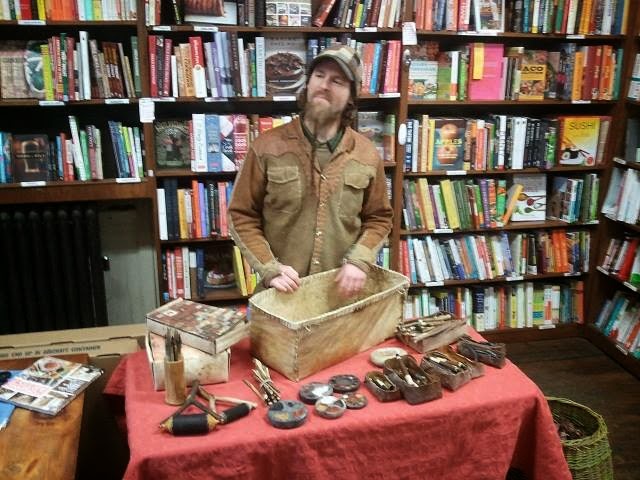
Nick came to Bear Pond Books on February 6th as part of the Montpelier Art Walk. Fans of every age came to look at his array of homemade pens, brushes, crayons, ink rollers, ink pots, and inks to go in them. They also got to see Nick working on a picture of staghorn sumac drawn with sumac ink and a pen made with a sumac twig. The infamous cat drawing was there. And you can see other examples of Nick's work at his website www.nickneddo.com


Nick says that he sees how older children quickly lose the creative instinct to make art from the natural materials surrounding them. Perhaps because they get frustrated when their pictures don't look the way they imagine, or maybe because they start to sift out into "artsy" kids and "outdoors" kids - one group hunts deer, the other draws them. One goal of the book, and classes he teaches, is to get kids who are interested in art also interested in nature, and kids interested in exploring nature interested in art . . . and for the ones already interested in both, so much the better. 

The Organic Artist taps into an impulse to blend nature and art that a lot of us have forgotten was there to begin with. It's an intriguing source of inspiration for art classes, history classes, and environmental studies. Nick may also be expanding his workshop offerings for folks who want instruction beyond the book. Learn more at www.nickneddo.com.

(Review by Helen)

Saturday, January 31, 2015

Katherine Roy's Neighborhood Sharks - February 7th, 11:00 am


We're excited to have author, illustrator, Center for Cartoon Studies graduate, and NYC resident Katherine Roy coming to the store next Saturday (February 7th). She will be here at 11:00 am as part of our author-educator series. Katherine's debut picture book Neighborhood Sharks vividly recreates a day in the life of a shark and reveals why sharks are essential to our ecosystem and deserve our protection. She'll share behind the scenes information on how she researched this book on the water with Bay Area shark scientists and show how she turns information into storytelling and creates a book from start to finish.

We're excited about this event for several reasons.

Bonus New Reason (as of 2/2/15): Neighborhood Sharks is a Sibert Honor Book. The Robert F. Sibert Medal is awarded annually by the American Library Association to the most distinguished informational books. You can read a description of the medal here.

1. Katherine is a really talented author and illustrator. You may have seen her illustrations before in local author S.S. Taylor's Expeditioners series. Her debut picture book, published under David Macaulay's new imprint at MacMillan, is getting a lot of attention. It uses the feeding patterns of great white sharks to explore biology, ecosystems, and how scientists study key species. The illustrations are just as engaging as Jaws ever was.


Here's a short list of some of the press Katherine has received:
 
2. Katherine is dedicated to sharing information about how she makes her books and giving readers, students, and teachers resources for learning more about both her subject and her process. Her website (www.katherineroy.com) is worth serious exploration, full of blog posts, pictures, and videos. Here are some examples of Katherine talking about her research and how she makes her books:
 
3. Katherine is bringing elephant videos from her next project, and last week's speaker Laurel Neme already has us primed to be fascinated by studying wildlife around the world.

4. Katherine is a Center for Cartoon Studies graduate, and we just think that's very cool. 

5. We're getting in some new baking cookbooks and need to try out recipes. There will also be something healthy, but that's less exciting.

Katherine's work is truly interdisciplinary, capturing the best of scientific research and visual storytelling. If you have an interest in science, ecosystem studies, drawing, stories, or just ideas about communicating information in an engaging way, please join us on Saturday, February 7th at 11:00 am! The event is free and open to the public.We provide certificates of attendance to educators who can use these workshops for continuing education credits. And we always offer 20% off books purchased for school classrooms and libraries.


Tuesday, January 27, 2015

One Orangutan = Lots of Things to Learn (with Laurel Neme)


Writer Laurel Neme has investigated a lot of wildlife stories over her career, and written for a diverse range of outlets, from the environmental news site Mongabay.com to her podcast The WildLife to a new picture book Orangutan Houdini.

Laurel's interest in writing a picture book after writing for an older audience began with the influence books about animals had on her when she was young, sparking an interest in this topic. Laurel channeled this interest in animals and wildlife into writing, but sees how an initial spark of interest can lead in many directions. For example, she says, "wildlife forensics [her primary focus]. . . is a new science, which means that there are a lot of discoveries to be made, a kid today who gets interested in this [field] will have many chances to make a new discovery."

The idea of a starting spark of curiosity begetting more curiosity and branching out into new discoveries informs how Laurel presents her work to classes and educators.

On January 24th, Laurel talked educators through one network of exploring across many subject areas starting with the example of her book Orangutan Houdini. This book tells the story of Fu Manchu, a real life orangutan who lived in a Nebraska zoo. Fu traded treats with an older orangutan for a length of wire she could pull from the light fixture in her cage. He could use that wire to pick the cage locks whenever he felt like roaming outside. The zookeepers knew he used something to pick the locks, but never could find what it was because Fu hid the wire in his mouth. When he was finally moved to a more secure enclosure and his keepers admitted they couldn't figure out his trick, he showed them where the wire was hidden. He never tried using that trick to escape again. As Laurel says "Once he knew the jig was up, he was done."

Fu Manchu wasn't alone. Laurel has heard a lot of orangutan stories like Fu Manchu's. There was Ken Allen, an ape at the San Diego zoo, who liked to escape so he could hang out with the human tourists (the zookeepers brought in Swiss mountaineers to figure out what handholds he might be using). Another orangutan enjoyed the trick of unlocking all the other orangutans' cages at night so they could switch places before the zookeepers returned to let them out in the morning.

This stories aren't just about particularly interesting orangutans. They show orangutans' ability to plan, to use tools, to anticipate what the zookeepers will think or do so that they can hide their tricks, and that they enjoy a challenge. These stories are part of the larger mystery of animal intelligence.

Another example of orangutan intelligence is how some of them learn language. They can't vocalize in the way humans do, but can learn to understand what we say and respond using symbols. For example, Rob Shunaker (currently at the Indianapolis Zoo) has worked for decades with Azy, an orangutan who communicates using symbols on a computer screen. You can see a video of the two working together that Laurel uses in classroom presentations here. Another example is Chantek, an orangutan who uses sign language and has other skills including making jewelry (for fun) and (according to Wikipedia) giving the directions to get from his home at the research center to the nearest Dairy Queen. Chantek is known for inventing words when he doesn't know the exact symbols, for example "tomato" plus "toothpaste" = ketchup.

Laurel has discovered that younger children particularly enjoy seeing how the orangutans learn language because it mirrors how they study parts of speech (Azy, for example, knows nouns and verbs) and also connecting symbols to words (known in human parlance as "reading").

How did orangutans get so smart? 

One theory is because they spent a lot of time sitting in trees and thinking. Orangutans are the only fully arboreal ape. They don't have many natural predators, and they pretty much sit up out of reach anyway. That gave their ancestors time to look around and ponder.

Fully Rotating Hips - Picture of a Sumatran Orangutan from Wikipedia
Whatever the connection to trees and thinking, you can see clear evidence how the orangutan's body matches its tree-to-tree existence. They have an arm span that is 1.5 times their height - or about the same as an NBA basketball player's arm span. They also have fully rotating hips, in addition to rotating shoulders. Laurel's teacher's guide to Orangutan Houdini includes examples of building math lessons from these measurements.

In addition to looking at the engineering of an orangutan's body, you can also study their movement patterns - and how these patterns suggest a different personality than other great apes (Gorillas, Chimpanzees and Bonobos). In this YouTube clip, movement coach Terry Notary demonstrates the differences.

Apes have no tails. Monkey have tails. Curious George? No tail

Tree top life is only one component of the orangutans' habitat. These trees grow in the rainforest of only two islands: Borneo and Sumatra. The peat swamps common on these islands help explain some of the orangutan's color. They create a muddy, orange-ish color that reflects up from the ground, while the sunlight filtering down through the trees' canopies reflects green and absorbs some of the orange colors . . . making muddy orange an excellent camouflage. Laurel's teacher's guide includes activities for discussing the rainforest ecosystem.

Orangutans play an important role in the traditional cultures in the places where they're found. The name "orangutan" means "Man of the Forest" in the Dayak language of that region. These cultures have strong beliefs about protecting orangutans, which are not necessarily honored by others. Like many animals adapted to habitats that cover only a small area, the orangutans face threats from loss of those habitats due to human activity.

Palm oil production is one major factor in destroying the places where orangutans live. Palm oil is very common in food manufacturing. In some ways it's a great oil to use - it's plant-based, stable, and the oil palm trees require relatively little land to grow. However, orangutan habitat is being cleared and peat swamps burned to open space for planting the oil palms. Burning or draining the peat swamps additionally releases large amounts of carbon (20 times more than with neighboring forests not on peat according to Mongabay). A switch to "deforestation-free" palm oil that focuses on using land that has already been disturbed instead of clearing new land is one solution. "That's a harder story to tell," Laurel notes, "It's easier to say 'no' to palm oil. . . but the goal is really sustainable oil production."

Other concerns for orangutans are the capture of babies for the illegal pet trade and treatment of animals in the entertainment industry.

A lot of Laurel's writing has to do with the threats facing wildlife. She's found that kids can take an active, effective part in advocacy. We have an entire post focused on kids and advocacy, which we've updated with new information following Laurel's talk.

That's a snapshot of some of the things you can learn from the starting point of one story about an orangutan playing a trick on its keepers. Laurel has more ideas written out as classroom activities in her Teacher's Guide for Orangutan Houdini found on her website www.laurelneme.com. She encourages any feedback teachers have to offer.

And get ready for our next workshop with Katherine Roy, author / illustrator of Neighborhood Sharks. Find out how she does her research and how she turns that research into storytelling, Saturday, February 7th, 11:00 am.

Laurel signs copies of Orangutan Houdini